Midwest and Northeast; nationally reusable
Build a Source-Aware Winter Starting Card From Your Fall Notes
A winter starting card should retain the latest usable source notes, coach context, and qualified course checks. It is a reference to revisit, not a forecast of future performance.
Use this in the app: import the session, keep the clubs in Bag DNA, and compare one shot in Course Mode.
Related Golf Notes: Create a Fall Club Card Before Your Next Simulator Session · Carry vs. Total: Which Number Belongs on Your Club Card? · Normalized Simulator Distance Is Not Tomorrow's Outdoor Yardage
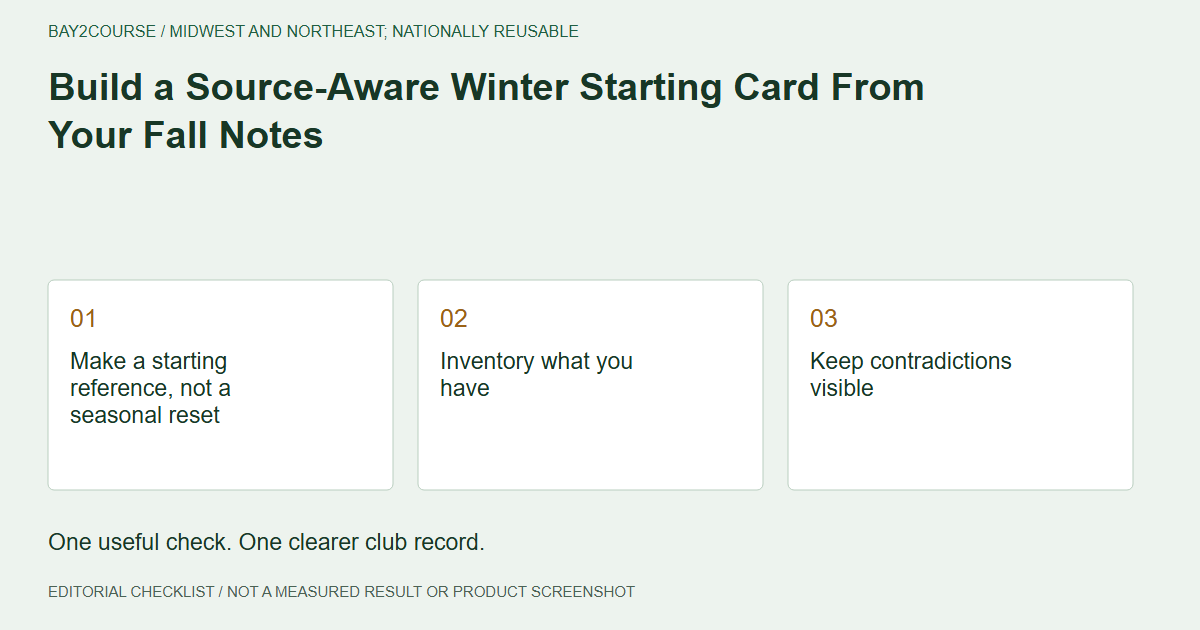
Make a starting reference, not a seasonal reset
A winter starting card should carry useful fall evidence forward. Do not erase awkward observations just because the next practice block will be indoors. Begin with the latest understandable source record, the relevant coach context, and any qualified course checks that still matter.
For Midwest and Northeast golfers, moving indoors is a practical scheduling choice that depends on actual circumstances. The USGA identifies frost delays as part of fall golf, but that does not establish when your course closes or when every golfer should change routines.
Inventory what you have
In a personal review, list the relevant records by source and date. Separate simulator carry, coach notes, and course observations. Mark entries whose metric or circumstances remain unclear. This makes it possible to choose a starting reference without pretending the entire season produced one consistent measurement.
Recency alone is not the deciding factor. A newer entry with an unknown label may be less interpretable than an older documented one. Ask what each record actually supports and what further information would be needed before changing the card.
Keep contradictions visible
Suppose a fictional fall record contains a clear indoor baseline and a course note saying the first landing was not seen. Those entries should not be averaged into a revised yardage. The second does not supply a directly comparable carry measurement.
Use the short note for the unresolved issue, such as 'Winter baseline; outdoor question open'. It fits within 50 characters. Keep the longer fall review separately so the new starting card remains readable without hiding the reason a question was carried forward.
Document the first indoor visit
Confirm the actual metric label, units, mode, and known settings before comparing the new session with the fall record. Trackman's historical normalization explanation illustrates why modeled source context matters, but it does not establish current defaults for the venue you are visiting.
Do not treat the first winter result as an automatic replacement. If it clarifies a missing source detail, record that progress. If it creates another unresolved comparison, preserve the distinction and choose what to ask next rather than forcing the numbers to agree.
Give the next month a narrow objective
Select one task that will make the starting card more useful: clarify a source label, revisit a coach question, or obtain a suitable outdoor observation when access allows. A narrow objective is easier to evaluate than a broad promise to rebuild every distance in the bag.
Share the relevant context with your coach if that helps choose the task. When outdoor access becomes feasible, check current local information and operator instructions. The winter card is a reference to revisit, not a forecast of performance or a claim that autumn uncertainty has disappeared.
A worked example
DEMO - fictional winter starting-card review.
| Keep | Clarify | Next task |
|---|---|---|
| Documented simulator baseline | Unknown source setting | Ask the venue |
| Qualified course observation | Unseen first landing | Wait for suitable opportunity |
| Relevant coach context | Current follow-up question | Review with coach |
Common questions
Should I start a completely new baseline every winter?
A new season alone does not establish that the old record is wrong. Review its relevance and source context first. Preserve useful evidence and make corrections only for reasons you can explain.
What if two fall observations conflict?
Keep both with their context rather than averaging unlike evidence into a tidy number. Identify the unresolved question and choose a next task that could clarify it.
Sources and further reading
Primary references behind this guide. Local course instructions and current weather take priority over seasonal averages.
- www.trackman.com/blog/normalization feature explained
- www.usga.org/content/usga/home page/articles/2018/10/fall golf 5 things every golfer should know.html
Written by Bay2Course, the maker of the app. This is practical record-keeping guidance, not independent equipment testing or a claim of professional coaching credentials. How we prepare and correct guides.
Explore: how it works · for coaches